
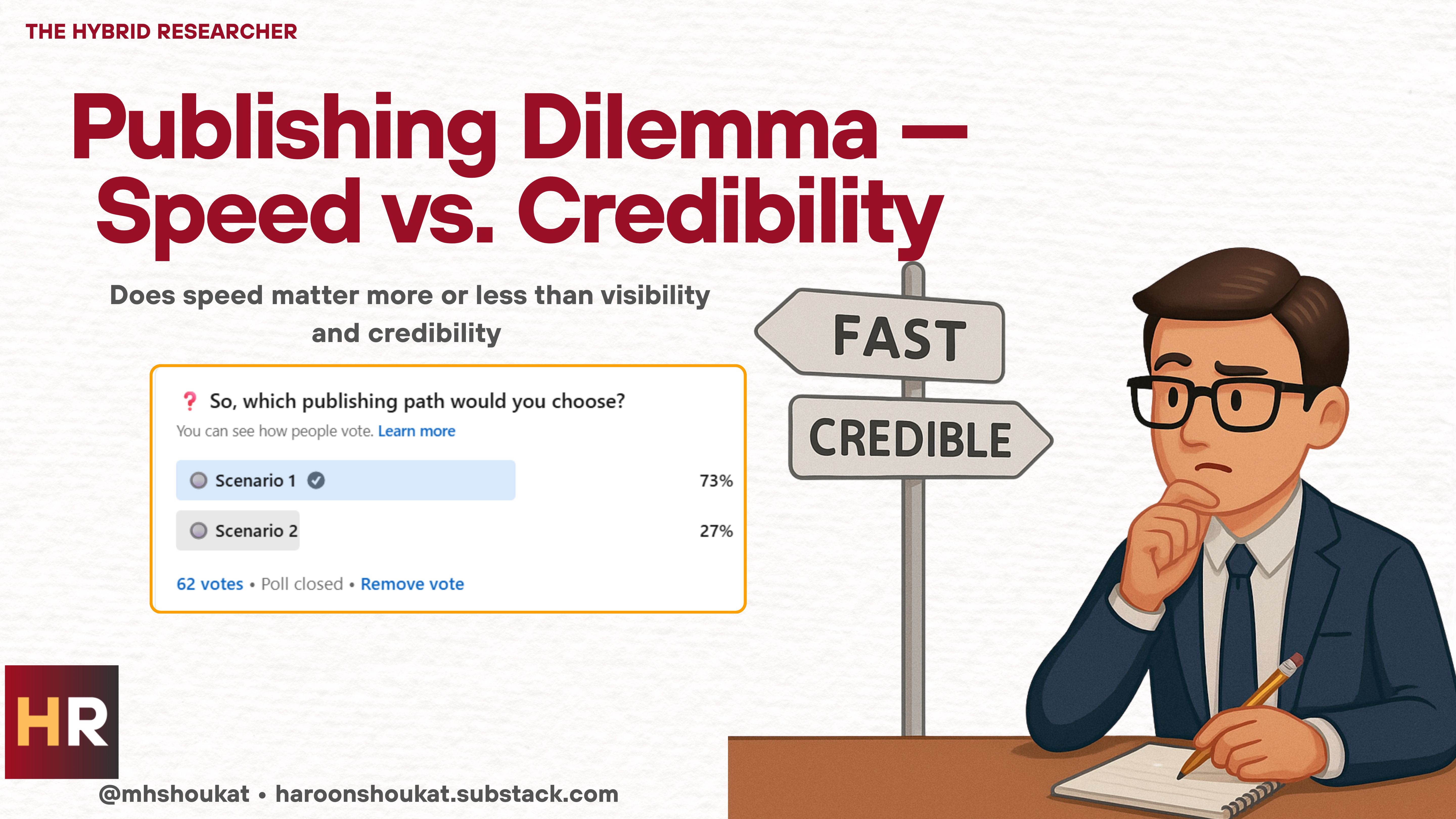
Publishing Dilemma — Speed vs. Credibility
Does speed matter more or less than visibility and credibility?

The Poll That Sparked a Real Debate
Last week on LinkedIn I asked:
Which publishing model would you choose?
Scenario 1 — Journal A (High Impact Factor) • Review time: 9–12 months • APC: $2,000+ Scenario 2 — Journal B (Low/No Impact Factor) • Review time: 2–3 months • APC: $0–$300
Results: 73% chose Scenario 1 (slow/credible), 27% chose Scenario 2 (fast/affordable).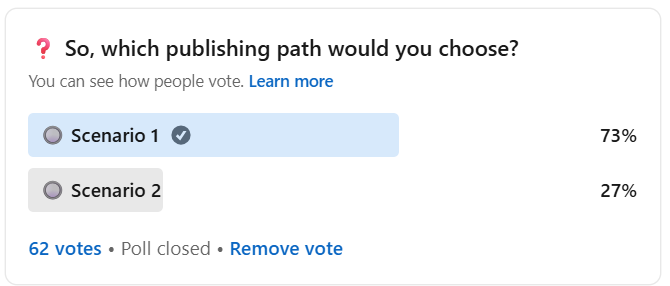
Behind those numbers is a tension every researcher feels:
Do I publish quickly to tick boxes—or wait longer for visibility, citations, and career weight?
The Publishing Paradox
In academia we juggle two forces:
Speed — degree deadlines, annual reviews, grant progress reports.
Credibility — journals that shape conversations, attract citations, and open doors.
Fast satisfies short-term goals, but can dilute long-term impact.
Credible takes patience/resources, but compounds over time.
The right choice depends on your stage, constraints, and goals—but the trade-off is real.
My Early Lesson: Speed Felt Great… Until It Didn’t
My first acceptance came fast—about 8 weeks. I was euphoric. Then months passed with almost no citations. The journal had limited readership; the paper made little dent.
A later article spent nearly a year in review at a top journal.
Painful wait. But that single paper delivered: steady citations, collaborations, invitations.
It moved my career forward in ways five rushed pieces never did.
Conclusion I wish I’d learned sooner:
Credibility compounds. Speed expires.
What Our Poll Answers Reveal (and What to Do)
1) The PhD Candidate’s Reality
If you need 2 papers in 12 months, Scenario 2 looks rational.
But committees often value one anchor paper over multiple low-visibility ones.
If you can, plan for a mix: one credible anchor + a couple of supportive, faster outputs (datasets, short notes, methods pieces).
Playbook:
Pitch one study to a field-leading (not necessarily “top-1%”) journal.
Spin off registered reports, protocols, or data papers to keep momentum.
2) The Early-Career Faculty Dilemma
Institutions sometimes reward quantity; funders often reward quality.
If your target is tenure, you need both.
Weight your pipeline so 1–2 papers/year aim high, while 2–3 service the “deliverables” culture.
Playbook:
Maintain two tracks: Impact Track (patient, rigorous) + Throughput Track (applied, short formats, invited pieces).
Use preprints to show progress while high-impact reviews are ongoing.
3) Industry or Policy Researchers
Here, time-to-insight often matters more than impact factor.
Scenario 2 can be ideal—especially for white papers, standards, or fast-moving fields.
Credibility is built through adoption, implementation, and stakeholder trust, not only citations.
Playbook:
Publish in open, practitioner-read outlets.
Pair results with implementation guides and case studies.
Practical Ways to Balance Speed & Credibility
Timebox the writing. Create a 30/60/90-day plan with weekly checkpoints.
Journal targeting script. Shortlist 3 journals: fit, timeline, APCs, and formatting burden.
Preprints & OSF. Share early to build visibility while you aim high.
Quality up front. Use checklists, style guides, and a response-log template to reduce R&R loops.
Collab smart. Invite a stats co-author or a field expert early to avoid last-minute overhauls.
Think in “assets.” Datasets, code, protocols, diagrams—each can be published separately to show progress.
📌 If you missed it last week… Our Researcher Planner: A 30-Day Challenge went viral — helping thousands of scholars structure their research workflow with daily habits, weekly milestones, and ready-to-use templates.
👉 Read it here and get your copy on Substack: FREE 30 Days Planner
🧭 A Simple Decision Map
If you need fast evidence of progress:
Preprint now → Submit to a credible journal → Share methods/data as short communications.
If you need a high-impact anchor for career moves:
Invest in study design, visuals, and positioning → Target a journal with strong readership (not just high IF) → Expect 2–3 revision cycles.
If funding/fees are the bottleneck:
Look for fee-waivers and society journals; many offer discounts for early-career or LMIC authors.
Consider diamond/open journals with robust editorial standards.
Real-Life Examples
“One strong paper changed my trajectory.” A colleague spent 11 months refining a single cross-disciplinary piece. It landed in a reputable journal, became his most cited work, and led to an international collaboration. That one article carried more weight than four “quick wins.”
“Strategic stacking.” Another team used a ladder approach: a preprint + a data note + the core paper in a strong journal. The early outputs created trust and visibility; the anchor paper reaped the citations.
“Industry impact, zero IF.” A policy brief (no impact factor) adopted by a government agency drove massive real-world change. Not highly cited—but highly consequential. Remember: impact ≠ IF only.
Reflection Prompts
Have you ever regretted publishing too quickly—or waiting too long?
Would you trade five low-impact papers for one credible anchor if it delayed you six months?
How does your institution actually measure success: count or consequence?
Hit reply and share—I'll feature a few perspectives next issue.
Mid-Issue Resource (center feature)
Get the full 30-day system I use: 👉 The One-Month Research Paper Blueprint — daily tasks, weekly milestones, PRISMA/search logs, evidence matrix, conceptual maps, and submission/ethics checklists. Download on Substack:
https://haroonshoukat.substack.com/
If you commented PLAN on LinkedIn, this is the roadmap I promised.
🧠 My Bottom Line
Publishing is more than filling a CV. It’s shaping conversations you want to be known for. Fast papers check boxes.
Credible papers open doors.
Your best career bet: one anchor study per year that you’re truly proud of—supported by smaller, strategic outputs that keep momentum and signal progress.
🔗 Bonus— Responsible AI & Research (highly recommended)
Before you go, a resource I personally endorse:
Dr. Paras Karmacharya, MD MS (NIH-Funded Physician-Scientist) shares Researcher-First, Minimalistic, Ethical AI plus timeless clinical research systems. Grab his excellent free guide: “How to Start Using AI Tools for Research Today.” 👉 Download FREE:
Until next time, Muhammad Haroon Shoukat The Hybrid Researcher
P.S. If this resonated, forward it to a colleague who’s weighing speed vs. credibility right now.
I really enjoyed this post. I was wondering if the founding member donation is a one-time payment or an annual subscription. I will consider upgrading to a paid subscription down the road. Thanks for this wonderful post.